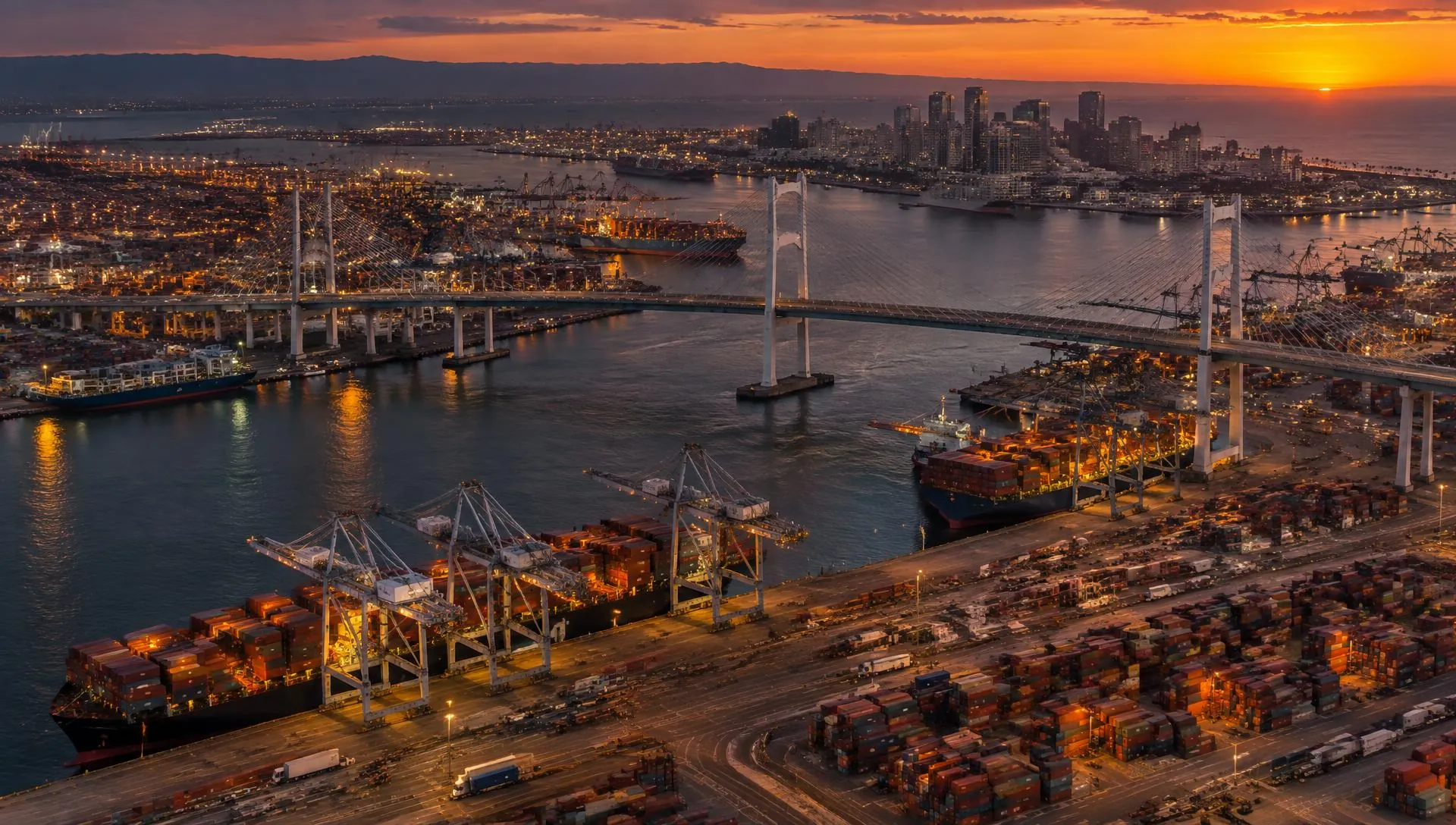

Port of Long Beach logistics, Southern California markets and nationwide trucking.
Get a quoteBonded Drayage to Foreign Trade Zones
If you are moving an imported container from the Los Angeles or Long Beach port into a foreign-trade zone, bonded drayage is the truck leg that carries it there in-bond.
The move needs an in-bond application, a bond, CBP's movement authorization and delivery within the allowed time. At the zone, the merchandise is then admitted on an application and permit.
If your container is waiting at a terminal and headed for a zone, two sets of federal rules shape what happens next. The in-bond rules decide whether the container may leave the terminal and how long it has to arrive. The zone rules decide whether the merchandise can be admitted once it gets there. When either set is missed, the container sits at the terminal waiting for authorization, or it reaches the zone without the paperwork for admission. The sections below follow the move in order: the zone's terms, admission, the in-bond leg and the drayage that connects them.
Foreign Trade Zone Terms Under 19 C.F.R. § 146.1
A few defined terms come up throughout the move, so they are set out first.
Under 19 C.F.R. § 146.1, "zone" carries the meaning given in the Foreign-Trade Zones Act. The same section defines a subzone as a special-purpose zone established as part of a zone project for a limited purpose that cannot be accommodated within an existing zone. The section also applies the term "zone" to a subzone unless the text specifies otherwise.
Under 19 C.F.R. § 146.1, to "admit" is to bring merchandise into a zone with zone status. The same section says "activation" means approval by the grantee and port director for operations and for the admission and handling of merchandise in zone status.
- An operator is a corporation, partnership or person that operates a zone or subzone under an agreement with the zone grantee, under 19 C.F.R. § 146.1. In practice, the operator's site is where the drayage leg ends.
- A user is a person or firm using a zone or subzone for storage, handling or processing of merchandise, under 19 C.F.R. § 146.1.
- Foreign merchandise is imported merchandise that has not been properly released from Customs custody in Customs territory, under 19 C.F.R. § 146.1.
- Zone status is the status of merchandise admitted to a zone: nonprivileged foreign, privileged foreign, zone restricted or domestic, under 19 C.F.R. § 146.1.
Status elections and any zone-specific requirements are typically confirmed between the importer and its licensed customs broker.
Admission to a Foreign Trade Zone: What 19 C.F.R. § 146.32(a) Requires
Once the container reaches the zone, admission is a separate step from the in-bond move.
Under 19 C.F.R. § 146.32(a)(1), merchandise may be admitted into a zone only on a sequentially numbered CBP Form 214 and after the port director issues a permit. The section names three exceptions to the CBP Form 214 requirement. The applicant presents the application to the port director along with a statistical copy on CBP Form 214-A, unless it has arranged to transmit the statistical information directly.
| Requirement | What the rule says | The section |
|---|---|---|
| Application | Admission is only on a sequentially numbered application for foreign trade zone admission and/or status designation | 19 C.F.R. § 146.32(a)(1) |
| Permit | The port director issues a permit for admission | 19 C.F.R. § 146.32(a)(1) |
| Exceptions | Merchandise temporarily deposited, transiting merchandise, or domestic merchandise admitted without permit | 19 C.F.R. § 146.32(a)(1) |
| Presentation | The applicant presents the application to the port director with a statistical copy for the Bureau of Census, unless it has arranged direct transmittal | 19 C.F.R. § 146.32(a)(1) |
| Single transmission with Importer Security Filing | Country of origin and the commodity HTSUS number, at the level the section names, are provided once | 19 C.F.R. § 146.32(a)(2) |
Under 19 C.F.R. § 146.32(a), the applicant for admission presents this application. The importer or its licensed customs broker handles that filing with CBP; the drayage carrier's part is getting the container to the zone.
The In-Bond Movement: Application, Bond, Authorization, and In-Transit Deadlines
The in-bond leg is what lets the container leave the terminal before duties are paid. Under 19 C.F.R. § 18.1(a), transporting merchandise in-bond means moving imported merchandise, secured by a bond, from one port to another before appraisement and without payment of duties. The same paragraph requires an in-bond application for this, made up of a transportation entry and a manifest. A transportation entry may be made for imported merchandise when it arrives at a port of entry, subject to the part's prohibitions and restrictions.
Under 19 C.F.R. § 18.1(c), three parties may file the transportation entry:
- the carrier, or its authorized agent, that brings the merchandise to the origination port;
- the carrier that moves the in-bond shipment to the port of destination or exportation, or its authorized agent, as 19 C.F.R. § 18.1(c) provides;
- any person, or that person's authorized agent, with a sufficient interest in the merchandise, as shown by the bill of lading, the manifest, a certificate of the importing carrier or another document. Under 19 C.F.R. § 18.1(c), CBP may request evidence of that interest.
Under 19 C.F.R. § 18.1(e), a custodial bond on CBP Form 301, containing the conditions of § 113.63, is required to transport merchandise in-bond. Under 19 C.F.R. § 18.1(f), CBP's authorization is required before merchandise can be transported in-bond, and CBP transmits that authorization through a CBP-approved EDI system.
Under 19 C.F.R. § 18.1(i), merchandise moved in-bond other than by barge is delivered to CBP at the port of destination or exportation within 30 days. Under 19 C.F.R. § 18.1(i), merchandise moved via barge for all or part of the in-bond movement is delivered within 60 days. Either period runs from the conveyance's arrival at the origination port, if the application was approved before arrival, or from the date of CBP's movement authorization, whichever is later. Also under 19 C.F.R. § 18.1(i):
- time held for an examination or inspection is not counted;
- a diversion or a new application does not extend the time;
- a late delivery is an irregular delivery;
- CBP may extend the period on written request, or any agency with jurisdiction may shorten it.
CBP's in-bond FAQ page says that the bonded movement from foreign trade zones requires in-bond applications filed through the electronic interfaces. The site's page on bonded drayage services covers the general in-bond rules.
How Bonded Drayage Fits the FTZ Move
The drayage leg begins only after CBP transmits the movement authorization under 19 C.F.R. § 18.1(f). It is the physical move of the container from the port terminal to the zone operator's site. It has to finish within the time 19 C.F.R. § 18.1(i) allows, and admission under 19 C.F.R. § 146.32(a) takes place after the container arrives.
Port drayage at the Port of Los Angeles and the Port of Long Beach is part of National Freight & Drayage's direct, asset-based Southern California port operations. Bonded drayage and a bonded warehouse are part of the service. In this workflow, National Freight & Drayage handles the truck leg between the terminal and the zone, the part of the move that runs between CBP's authorization and zone admission. The terminal-side detail is covered on the pages for Los Angeles bonded drayage and Long Beach bonded drayage.
Order of the move
CBP's movement authorization comes before the truck leaves the terminal, and the zone admission application and permit come at the zone.
Moving an In-Bond Container Into a Foreign Trade Zone
If you have a container headed in-bond from a Los Angeles or Long Beach terminal into a foreign-trade zone, National Freight & Drayage can run the truck leg from the terminal to the zone operator's site once CBP's movement authorization is in place. To discuss the move, contact National Freight & Drayage through its freight quote form.
Request a drayage quoteFrequently asked questions
What is a foreign trade zone?
A zone carries the meaning the Foreign-Trade Zones Act gives it, and the federal regulations apply that term to subzones as well. Merchandise brought into a zone with zone status is "admitted," and each admitted shipment holds one of the zone statuses described above. The importer confirms zone-specific treatment with its licensed customs broker.
What is needed to admit merchandise into a zone?
Admission needs a sequentially numbered admission application and a permit issued by the port director, apart from the exceptions the regulation names. The applicant presents the application to the port director with a statistical copy for the Bureau of Census, unless it has arranged to transmit that information directly.
Who may file the in-bond application?
The regulation names three parties: the carrier that brought the merchandise to the origination port, the carrier that takes it on to destination or exportation, or anyone with a sufficient interest in the merchandise. Each may also file through an authorized agent. CBP may ask for evidence of that interest.
When can the container leave the terminal?
The container can leave once CBP has authorized the in-bond movement. CBP transmits that authorization through a CBP-approved EDI system.
Does an exam stop the in-transit clock?
Yes. Time the merchandise is held for an examination or inspection by CBP or another government agency is not counted toward the in-transit period. A diversion or a new application does not extend the period, and a late delivery is an irregular delivery.